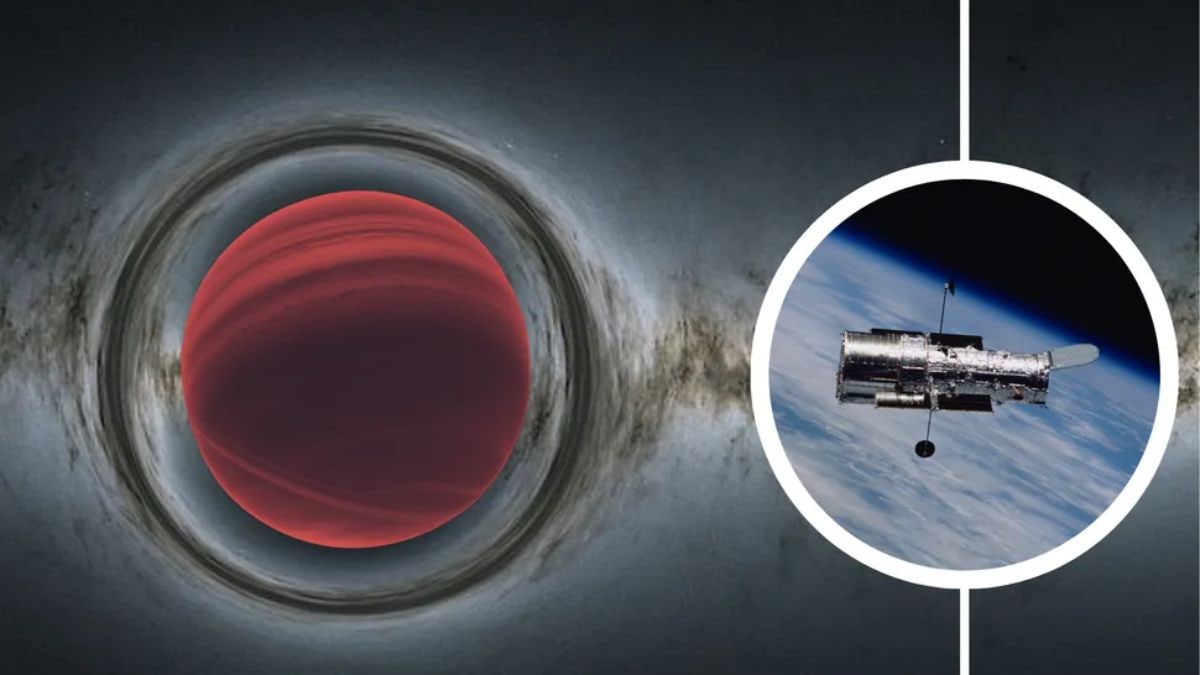
Astronomers discovered {that a} new rogue planet hides within the archival information that was gathered by the Hubble Space Telescope with the assistance of Albert Einstein and the occurring of the occasions by likelihood, resulting in success. These planets are also referred to as free-floating planets and don’t orbit a star. These are simply ejected from their house programs due to the planetary interactions. As they lack a bunch star, it’s troublesome to detect them by transit. However, the astronomers use microlensing with gravity, Einstein’s 1915 theory-based phenomenon of basic relativity, during which huge objects warp house and bend mild from the background stars.
Einstein’s Theory Helps Detect Hidden Rogue Planet
According to As per Przemek Mroz, a professor on the University of Warsaw free free-floating planets do not orbit any star and drift alone via the galaxy. In order to search out such objects, we have to use the strategy of gravitational microlensing. At the time of utilizing this system, the sunshine of the background star will get magnified quickly. The physicists estimate the mass of the item by analysing the properties of the occasion.
The newly discovered occasion of microlensing, OGLE-2023-BLG-0524, was seen by Hubble on May 22, 2023. Observed by KMTnet, the occasion solely lasted for eight hours and was found within the Galactic bulge by the OGLE survey. The workforce dominated out the presence of a bunch star; nevertheless, very close by parts cannot be excluded fully.
Microlensing Event Reveals Free-Floating Planet in Hubble Data
The lens and supply are extra relative to one another; the physicists verify the standing of the item over time. The motion of 5 milliseconds per yr may take 10 years to resolve with the current devices.
Hubble’s information from 1997 let the scientists rule out the brilliant host stars. Mroz mentioned that if the lens have been a vibrant star, we might have noticed it, however we couldn’t. This absence evoked 25%-48% of the attainable stellar companions. This analysis is accessible on arXiv.