
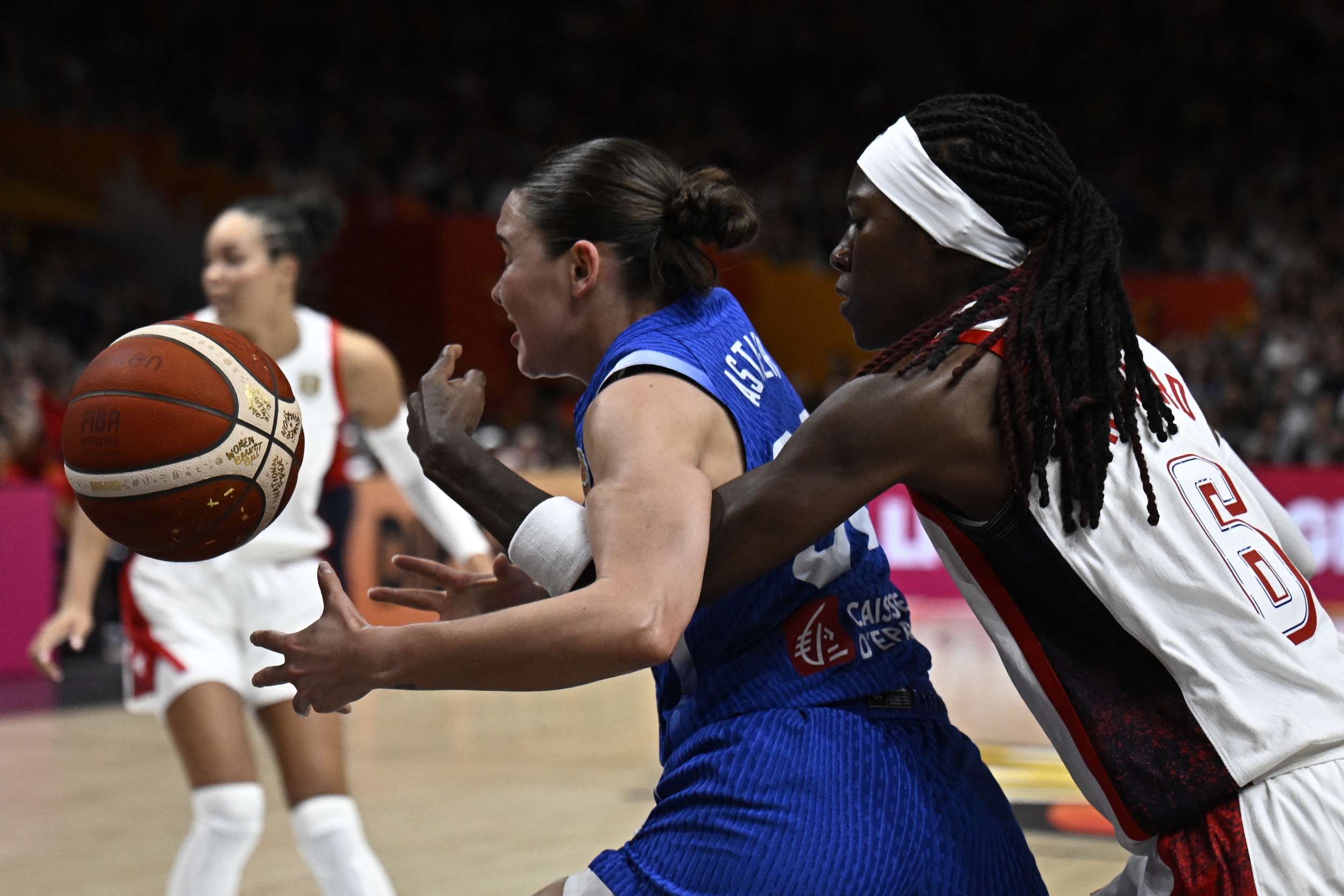
In the 2026 FIBA Women’s Basketball World Cup Final, France shot 59.3% efficient subject purpose share. That determine is above their knockout-round common, above their greatest efficiency in opposition to any elite opponent in Berlin, and nicely above what any of USA’s earlier opponents managed within the match. France didn’t lose by 18 factors as a result of they shot poorly. They misplaced as a result of USA shot higher, defended higher, and had a 3rd quarter that appeared like one thing from a special recreation completely.
That element is price sitting with earlier than anybody attracts conclusions concerning the two groups’ relative energy heading into the 2028 Los Angeles Olympics — which, if latest historical past is any information, will once more come down to those two.
Two video games. Two very totally different margins.
There isn’t any cleaner statistical abstract of the USA-France rivalry than the 2 most up-to-date championship finals.
At the Paris 2024 Olympics, USA gained 67–66. A’ja Wilson scored 21 factors, grabbed 13 rebounds, and blocked 4 pictures. France had the ball with an opportunity to tie or win. USA escaped by one possession.
Twenty-five months later in Berlin, USA gained 97–79. Wilson was absent — she didn’t play in your complete 2026 World Cup. France led 31–17 early within the second quarter. USA outscored them 30–12 within the third quarter and gained by 18.
The margin swung 17 factors in USA’s favor between the 2 video games, and their greatest participant was not even on the court docket. If you learn solely the scorelines, you would possibly conclude that USA has separated themselves decisively from France, that the rivalry has turn out to be a mismatch, that Paris 2024 was an aberration.
The information suggests a extra cautious studying.
What the offensive numbers present
Effective subject purpose share — eFG% — is the only most explanatory think about basketball effectivity evaluation, accounting for roughly 47% of the variance in group web score in line with up to date analysis on the Four Factors framework (Poropudas, 2023). The components weights three-pointers appropriately: eFG% = (subject targets made + 0.5 × three-pointers made) ÷ subject purpose makes an attempt. A group with a better eFG% is getting extra worth out of each shot, no matter tempo.
Across their 5 video games in Berlin, USA averaged 56.5% offensive eFG%. France averaged 59.5% throughout their 5 video games. On that foundation, France’s five-game offense was higher — however that studying requires context.
Both averages are formed considerably by blowout video games in opposition to weak opponents. France shot 74.6% eFG% in opposition to Nigeria in a 111–56 group-stage win — 22 made three-pointers in 40 makes an attempt in opposition to a group providing minimal defensive resistance. That one recreation pulls France’s five-game common up by roughly three share factors; with out it, France’s four-game common falls to roughly 55.8%. USA’s group stage was much less dramatic offensively: roughly 50.8% in opposition to China — a 33-point win constructed considerably on free throws moderately than elite field-goal effectivity — and 59.1% in opposition to Czechia.
Strip the group stage and look solely on the three knockout rounds for every group, and the image inverts. USA’s offensive common rises to 57.6% within the quarterfinal, semifinal, and Final mixed, versus France’s 54.5% of their three knockout video games — a 3.1-point hole in USA’s favor.
The extra revealing offensive element is how each groups carried out beneath strain. USA’s worst recreation got here within the semifinal in opposition to Spain — 42.5% eFG%, the place they shot 40% from the sector and 16.7% from three — they usually nonetheless gained 76–66. France’s knockout-round flooring was 52.1%, their constant determine in opposition to each China and Germany. Their ceiling in a full-length recreation in opposition to elite protection was the 59.3% they shot in opposition to USA within the Final.
Neither group’s offense is dramatically superior. The hole in knockout-round context is actual — roughly three share factors in USA’s favor — however it isn’t the first structural differentiator between these two groups.
What the defensive numbers present
This is the place the hole opens up extra clearly.
USA held opponents to 40.5% eFG% throughout their 5 Berlin video games. France held opponents to roughly 48.0% throughout their 5 video games — a spot of seven.5 share factors. In knockout rounds particularly, USA allowed roughly 50.1% and France allowed roughly 55.2%, a spot of about 5.1 factors.
Some of these figures require context. France held Hungary to roughly 39.5% and Nigeria to precisely 35.0% — each group-stage blowouts in opposition to considerably weaker opponents. Against their three knockout-round opponents, France allowed China to shoot roughly 52.2% eFG%, Germany roughly 50.0%, and USA precisely 63.5% within the Final. That 63.5% is the best determine France yielded to any opponent, and it’s 13 factors above their defensive common in opposition to China and Germany.
USA’s defensive averages comply with an analogous two-tier construction. They held group-stage opponents to 34–36% eFG% and allowed 52.2% to Spain within the semifinal — the one top-tier offensive group they confronted earlier than the Final. In the Final in opposition to France, they allowed 59.3%.
The constant hole is within the knockout rounds. When France confronted China and Germany, groups with real offensive capabilities, they allowed 50–52% eFG%. When USA confronted Spain and France, groups with real offensive capabilities, they allowed 52–59% eFG%. Both ranges overlap. But France’s defensive efficiency in these video games trending towards the upper finish — and USA’s five-game common remaining 7.5 factors decrease — displays an actual, if average, structural distinction.
The most placing defensive information level for France is the Final itself: 63.5% eFG% allowed to USA is considerably above their knockout-round common elsewhere. This could mirror each the standard of USA’s offensive execution — 66.7% within the quarterfinal, 63.5% within the Final, all with out Wilson — and France’s problem containing the highest-level opposition as soon as USA discovered its rhythm within the third quarter.
What the third quarter truly tells you
When France led 31–17 early within the second quarter — showing briefly like a major upset — it was not a defensive breakdown by USA. USA’s second quarter was blended. But within the third quarter, USA outscored France 30–12. France went from taking pictures above their knockout-round common to one thing that appeared like a special group.
Parsing a single quarter’s causation from field rating information alone is past the scope of what statistics can reliably help. But the defensive image throughout the match means that when USA’s protection engaged at full depth over a sustained stretch, France’s offense — environment friendly as it’s — didn’t have a structural response. They had no reply for USA’s greatest defensive effort.
What is not within the information
Three issues the statistics can not seize, and all three favor USA in 2028.
A’ja Wilson will virtually definitely be on the court docket in Los Angeles. In Paris, she was USA’s greatest participant within the ultimate. Her presence in 2026 could nicely have modified the Spain semifinal margin and the general trajectory of USA’s bracket. The 2026 information is a flooring, not a ceiling, for USA’s capabilities.
The 2028 Olympics are in Los Angeles. Historical information from main worldwide basketball constantly reveals a home-court impact. USA in LA is a special calibration than USA in Berlin.
France’s core contributors are younger. Players within the French rotation who’re of their early-to-mid-twenties have a growth runway earlier than 2028 that doesn’t seem in any present information — and the course of that trajectory is upward.
What the info helps and what it does not
This evaluation is descriptive, not predictive. Five video games per group, with a good portion of figures derived moderately than actual, doesn’t help a chance estimate. It doesn’t help a declare that the 18-point Final margin displays the true structural hole between these groups. What occurred in Paris in 2024 — France, one possession from gold — is an information level that doesn’t disappear as a result of Berlin occurred.
What the info does help: USA enters 2028 because the stronger group on at the moment accessible proof. Their knockout-round offensive edge is roughly three share factors; their defensive edge, roughly 5. Their offensive ceiling with Wilson — demonstrated by a 66.7% quarterfinal and a 63.5% Final with out her — just isn’t matched by France’s knockout-round information. They maintain a 2–0 head-to-head file in championship finals.
What France’s information helps: they’re probably the most succesful opponent USA has confronted in two straight main finals. Their offense within the Berlin Final was higher than their knockout-round common. Their younger roster has time to shut the hole. And in Paris, with Wilson and situations roughly equal, they got here one possession from successful.
The 2028 Los Angeles Olympics won’t be settled by a 30–12 third quarter in Berlin. But the group that managed that quarter managed this sport for the previous two years — and they’re about to play on residence court docket with their greatest participant again.
© Copyright 2026 Sports World News, All rights reserved. Do not reproduce with out permission.










![SatyaPrem Ki Katha screening: Sidharth Malhotra-Kiara Advani set couple objectives in white; Mrunal Thakur slips right into a dangerously high-slit costume and extra [VIEW PICS]](https://st1.bollywoodlife.com/wp-content/uploads/2023/06/Sidharth-54-600x315.png "SatyaPrem Ki Katha screening: Sidharth Malhotra-Kiara Advani set couple objectives in white; Mrunal Thakur slips right into a dangerously high-slit costume and extra [VIEW PICS]")

