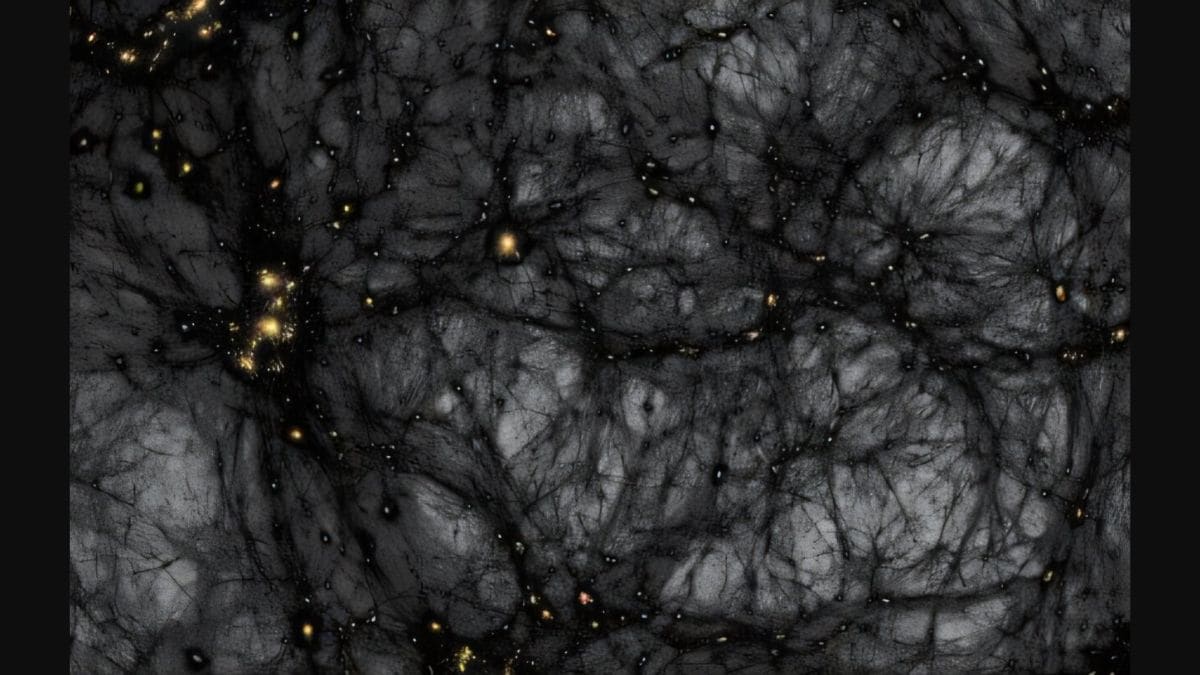
A bunch of physicists on the University of São Paulo’s Institute of Physics has proposed a mannequin of the behaviour of darkish matter (DM) within the presence of darkish power (DE) that’s suitable with present astronomical observations. A mannequin of inelastic DM may be realised from lightweight particles, that are collectively interacting by way of the large vector mediator, and the mannequin is another rationalization for DM relics within the universe. Importantly, this framework might have the potential to bypass the experimental hurdles for the detection of DM which have up to now stored it at midnight. The findings are printed within the Journal of High Energy Physics, and its authors imagine it has the potential to “revolutionise” how particle physics analyses are carried out sooner or later.
Light Mediator ZQ Offers New Clues to Elusive Dark Matter and Its Cosmic Origins
As per the customers’ report, they’ve developed the next new mannequin: a heavy, steady DM from a light-weight, unstable one. This may be expressed as a heavy steady DM resulting from a heavy unstable one, which can give rise to the “thermal freeze-out” in the universe. It doesn’t just interact with visible matter but with dark matter as well, and that’s how you get the new observational windows.
To explain why the dark matter has not been observed until now, the model further involves a decay of the unstable dark matter χ2 to some species not disturbing the CBR, and thus also not presenting a visible/observable decay signal. The picture is consistent with current astrophysical and experimental constraints, avoiding simpler `vanilla’ DM scenarios.
ZQ-induced vector mediators are light portals connecting the two sectors and may mediate the direct interactions between the dark sector and the SM particles. The black line indicates the region in the parameter space where dark matter can be hiding unobserved — this is to be addressed in future experiments.
The study suggests the search for dark matter should pivot from the “discovery frontier”, by which exquisitely delicate devices scan for alerts, to the “intensity frontier”, which seeks ever-finer measurements to tease out anomalies. Future experiments will search to dig extra deeply into these unexplained corners of particle physics with a brand new on-line software.