
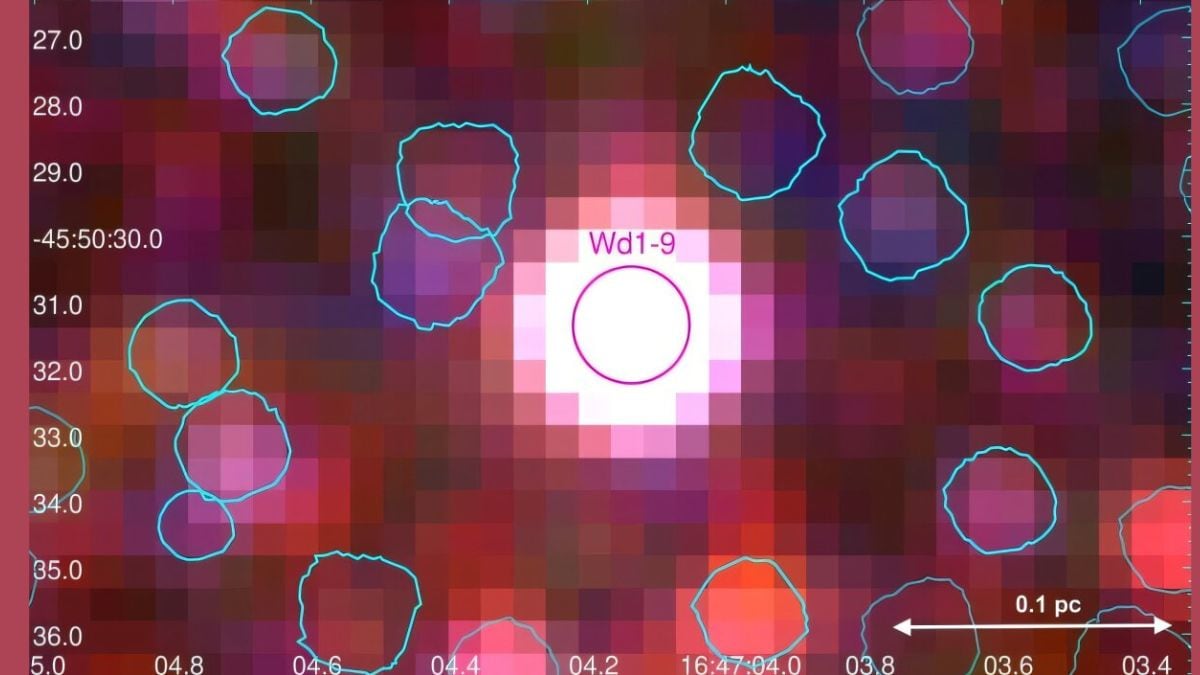
In the most recent version of the scientific investigations, it has come to gentle that the Chandra X-Ray Observatory of NASA has been employed by a world crew of astronomers to research a supergiant star referred to as Wd1-9. It has actually carried out an in depth investigation, which was accompanied by in-depth evaluation and supplied important insights. Considering the supergiant B Stars, these are fairly uncommon within the Milky Way. As these stars develop, they endure steady adjustments. These stars additionally exhibit sturdy Balmore emission strains, forbidden strains, and infrared extra.
Wd1-9: What is that this Supergiant B Star?
Wd1-9 is a supergiant B (e) star in Westerlund 1. It is situated at a distance of 13,800 gentle years from Earth. This star is the brightest radio supply current throughout the cluster. Likewise, the current findings introduced within the paper revealed on July twenty third, 2025, recommend that this star shows a wealthy emission-line spectrum. Significantly, no photospheric options had been detected.
Although Wd1-9 has been studied a number of occasions at totally different wavelengths, its true nature continues to be unknown as a result of it being lined by a cloud of mud. As the earlier analysis suggests, this star could also be a cool hypergiant or an interacting binary system. Now, to beat these suspicions, Konstantina Anastasopolou led a crew of the Harvard-Smithsonian Center for Astrophysics (CfA), Cambridge, employed Chandra to dig deeper.
What did the Astronomers Find?
As per the observations supplied by Chandra, it was witnessed that Wd1-9 displays long-term X-ray variability. The crew additional recognized an orbital interval that comprised a 14-day periodic sign. According to the astronomers, that is the primary interval willpower for the Wd1-9.
Significantly, the astronomers discovered that sturdy emission strains had been detected that surfaced from parts like silicon, sulfur, and argon. Similarly, the iron emission line at 6.7 keV was recognized for the primary time ever. These identifications have turn into part of the brand new findings.
To Conclude
According to the astronomers, the above-specified findings straight relate to binarity. The spectrum of Wd1-9 resembles the Wolf-Rayet (WR) binaries in Westerlund 1. Also, when the astronomers examined the X-Ray color-color diagrams, they recognized that Wd1-9 showcased variations in thermal temperatures. After analysing the findings and placing all of the examinations collectively, the scientists concluded that Wd1-9 is part of the binary system.















![SatyaPrem Ki Katha screening: Sidharth Malhotra-Kiara Advani set couple objectives in white; Mrunal Thakur slips right into a dangerously high-slit costume and extra [VIEW PICS]](https://st1.bollywoodlife.com/wp-content/uploads/2023/06/Sidharth-54-600x315.png "SatyaPrem Ki Katha screening: Sidharth Malhotra-Kiara Advani set couple objectives in white; Mrunal Thakur slips right into a dangerously high-slit costume and extra [VIEW PICS]")

