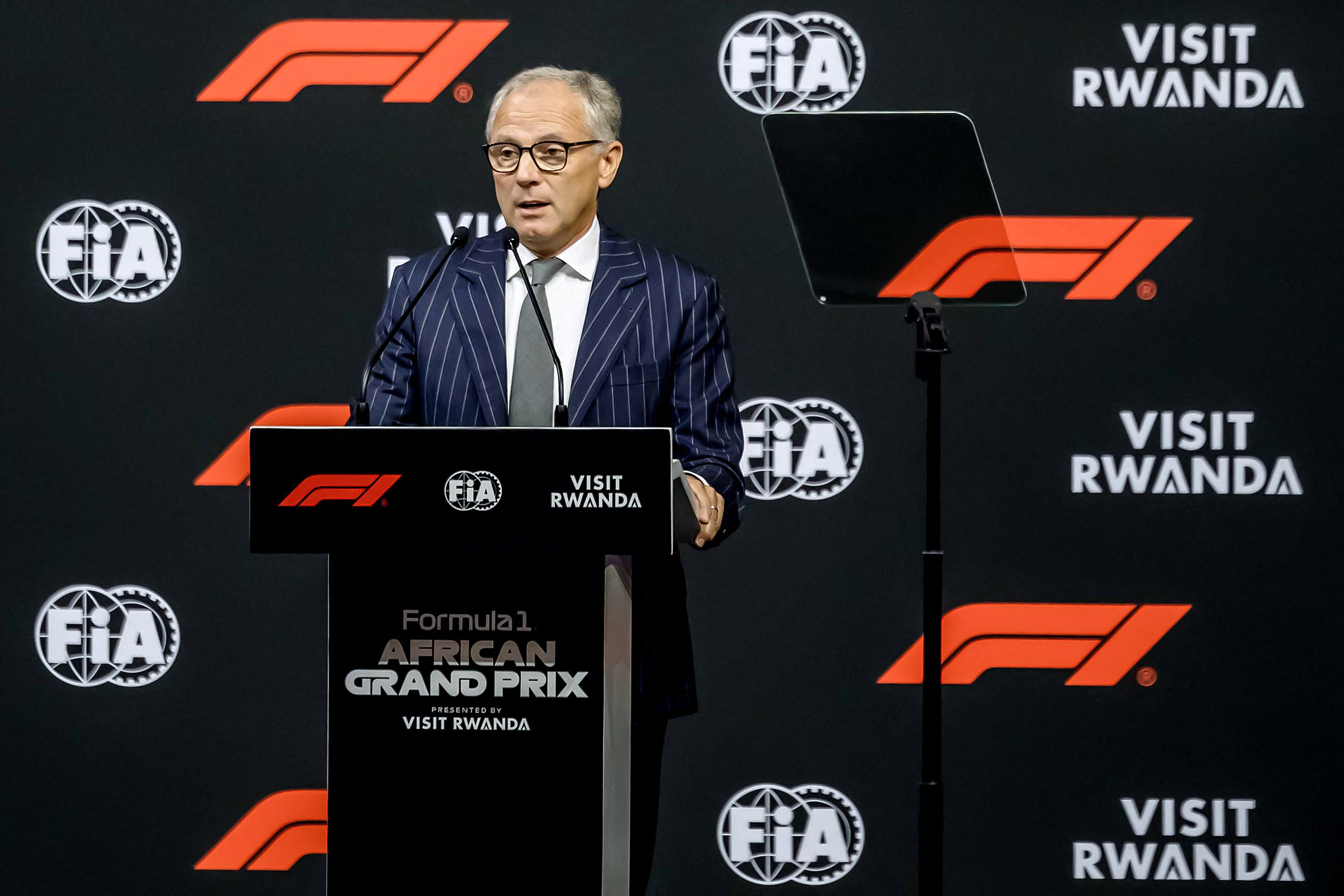
Stefano Domenicali had been speaking about partnership and legacy and the way forward for Formula 1 in Africa when he stated one thing that bought to the center of it.
“We were in a sort of chicken-and-egg moment,” the F1 CEO instructed the room on Tuesday at BK Arena in Kigali. “We were talking, having everything almost ready, and they said: listen, but if you don’t start, we’re going to get it. And we felt that responsibility.”
It was, for anybody paying consideration, the within account of how a deal virtually did not occur. Not as a result of both aspect lacked the will — F1 has been publicly dedicated to a return to Africa for years, and Rwanda’s authorities made no secret of its ambitions — however as a result of every occasion wanted the opposite to maneuver first. Someone needed to blink. And ultimately, Rwanda did.
Formula 1 final raced in Africa in 1993, at Kyalami in South Africa. In the 33 years since, the game grew into a world leisure property with over 800 million followers, expanded to 24 races throughout 5 continents, and — by its personal management’s admission — left its largest remaining market untouched. Mohammed Ben Sulayem, who took over as FIA President in late 2021, made improvement of motorsport in Africa considered one of his acknowledged priorities from his first yr in workplace. “Africa deserves more — not because we have to, because we want to,” he stated Tuesday.
That need, nonetheless, didn’t translate into motion for one more two years, partially due to the structural downside Domenicali later named. Any potential African host wanted proof that F1 was genuinely coming; F1 wanted proof {that a} credible host existed. In its absence, the dialog stayed on the degree of aspiration.
Ben Sulayem’s first seen transfer was institutional: in December 2024, the FIA held its General Assembly and awards ceremony in Kigali — the federation’s first formal presence in Africa in roughly 20 years. By his personal account, the go to required persuasion. “We had a few people who were resisting it and trying not to come here,” he stated Tuesday. “And I said to them: you don’t know what you are missing.” Both Ben Sulayem and Domenicali have since cited the General Assembly go to because the second that opened the trail to Tuesday’s announcement.
But the method had already begun at a lunch desk someplace in Kigali, a yr earlier.
In 2023, Alexander Wurz — the previous F1 driver who serves as each chairman of the Grand Prix Drivers’ Association and founding father of circuit design agency Wurz Design — sat down with Rwanda’s Minister of Sports, Nelly Mukazayire, and a small group of colleagues to debate the probabilities. Wurz stated Tuesday that on the time, all of them thought it was a dream.
What modified was not aspiration however accumulation. Rwanda had, since 2021, been methodically constructing the circumstances that may make an F1 bid credible: it hosted the inaugural Basketball Africa League in a COVID bubble — an audacious logistics train that established the nation’s capability to ship main worldwide occasions below stress. The 2025 UCI Road World Championships adopted, held in Kigali. Then the FIA General Assembly. Each occasion was a part of what Jean-Guy Afrika, CEO of the Rwanda Development Board, described Tuesday as a deliberate long-term technique: “We’ve used sports as a mechanism and an amplifier of tourism… F1 was a natural continuation.”
When Domenicali was requested Tuesday why Rwanda had been chosen over different African nations that had additionally expressed curiosity, his reply was unambiguous. “We are in a world where a lot of people love to talk and a lot of people love to work,” he stated. “Of course there has been a lot of discussion with other countries — respectfully — of Africa. But the determination of the president and his team, the determination related to the job that they presented together with us, makes us very, very comfortable that this is a long-term journey.”
The timing anchor of the “early 2030s” dedication is, in concrete phrases, the brand new Bugesera worldwide airport — at the moment below development adjoining to the circuit website, increasing Rwanda’s capability from two million to almost 5 million passengers yearly, and attributable to full in early 2028. With that facility in place, the infrastructure case for internet hosting 100,000 spectators over a race weekend — drawing followers from Nairobi, Lagos, Johannesburg with a single connection — turns into self-evident. Afrika stated the imaginative and prescient prolonged past a single race. “We foresee a future where we look back at this moment and see a critical juncture from where multiple races eventually end up happening in Africa.”
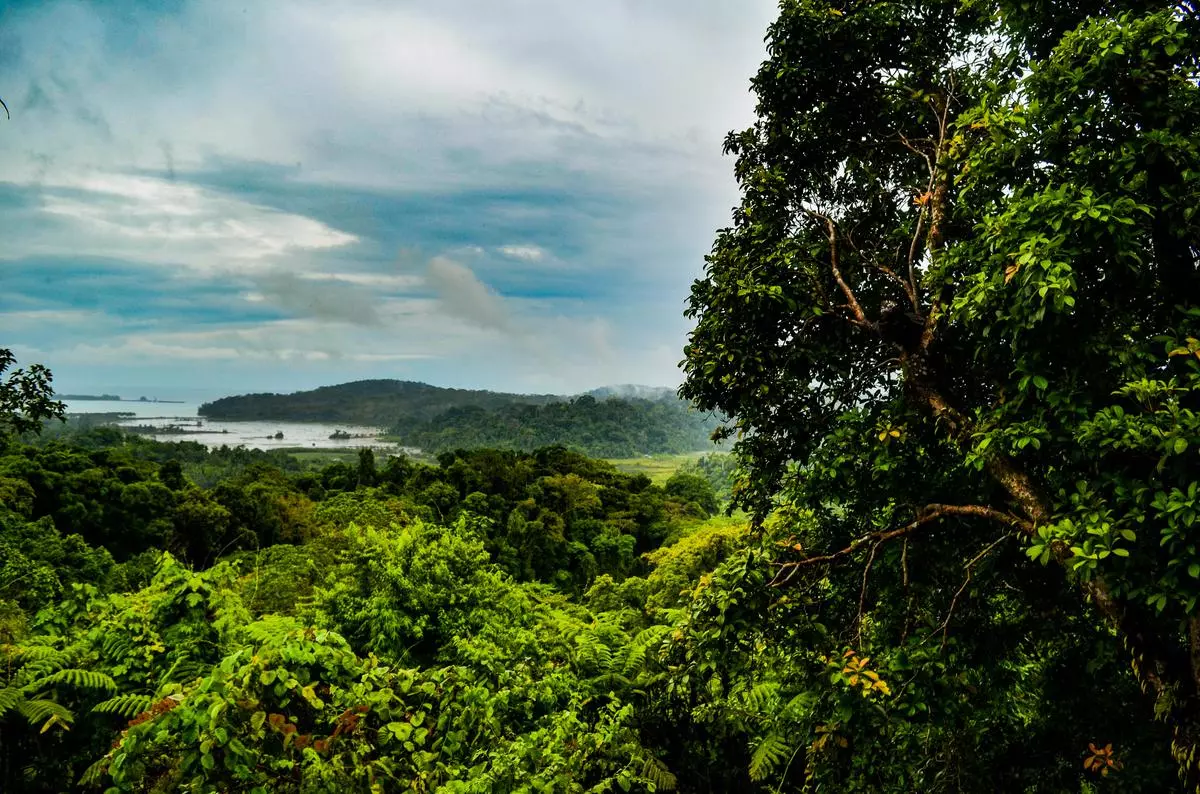
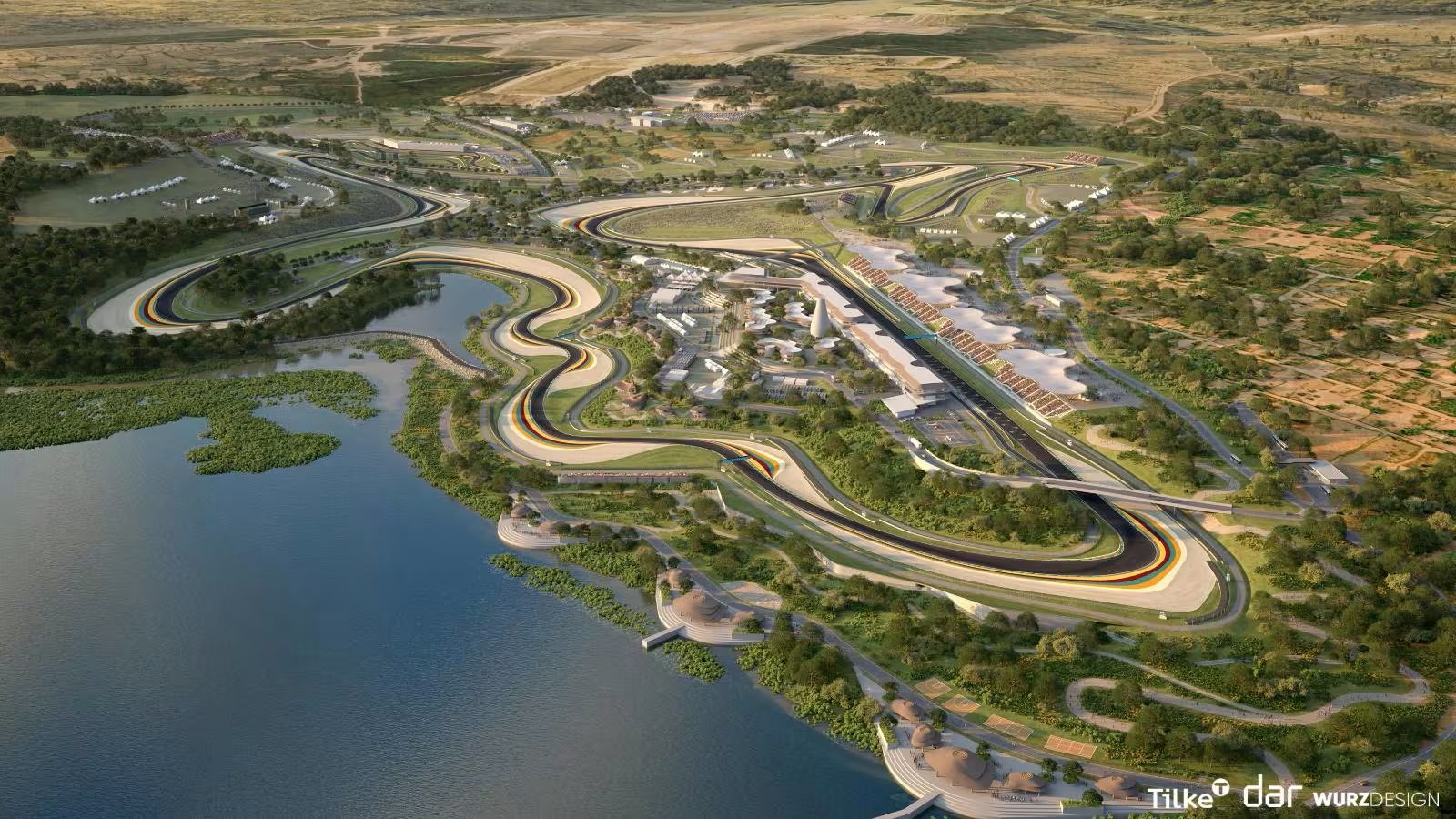
The circuit that can host these races sits between two hills above a lake in Bugesera. When Wurz first noticed the location, he made an evaluation that circuit designers hardly ever get to make: the land had already performed many of the work. “Only one location,” he instructed the press convention Tuesday. “It doesn’t need us to design it — the nature designed already the perfect topography. It’s two hills with the lake below.”
The ensuing format — six kilometers, 17 corners, working anticlockwise — will produce 197 meters of elevation acquire per lap, a determine that Carsten Tilke, the circuit’s technical lead, confirmed Tuesday is a document for the Formula 1 calendar. The circuit rises and drops at gradients of 12 to 13 % and incorporates banked corners.
Turn 2, Wurz stated, is the nook that can outline the monitor’s character. “You come in at top speed down the hill with over 10 percent descent and go into a compression where you experience high G-forces vertically and laterally. The corner is then going into 12 percent, and then the exit — when you go all the way up the hill, you’re facing sky with almost 15 percent of incline, and you’re still at 240 kilometers per hour, having just undergone so much G forces.” He paused. “That’s one of the corners I can’t wait to see the races unfolding.”
Asked about driver response, Wurz was cautious — the complete format stays below embargo — however pointed to his eyes as he stated it: greater than a dozen FIA World Champions have personally seen the circuit and reviewed onboard video. He declined to call them. He has run hundreds of laps himself. “I’m the lap record holder,” he stated.
The paddock attracts straight from Rwanda’s constructed surroundings: terraced into the hillside, organized as a village of staff amenities reasonably than a traditional pit lane configuration, constructed from native supplies and impressed, Tilke stated, by the pink earth seen throughout the Rwandan panorama. It is designed to host MotoGP, the World Endurance Championship, decrease formulation, concert events, and automotive producer occasions year-round — the economics requiring, as Afrika put it, “year-round utilization, not just a single weekend.”
The query of grassroots entry — whether or not anybody from Rwanda or the broader African continent may really progress towards a profession in motorsport — was the one Ben Sulayem addressed most bluntly. “Who can afford having his daughter or his son in karting, which all of the Formula 1 drivers came from?” he requested Tuesday. “You’re talking about 200 to $250,000 for a season. So what is it going to be — the rich man or woman’s club? It cannot be like this.”
The FIA’s reply is a brand new, lower-cost kart to be launched for African improvement applications, and the cross automotive program already underway in Rwanda. Students on the Integrated Polytechnic Regional College in Kigali have constructed the primary cross automotive from the FIA-backed manufacturing mission; by the second quarter of 2027, they may have constructed ten — vehicles already being utilized in regional competitors, with one taking part within the Kenyan leg of the World Rally calendar.
Ben Sulayem’s funding in Rwanda’s younger drivers predates Tuesday’s announcement. When Max Verstappen served a disciplinary community-service requirement in December 2024 — on the identical day because the FIA General Assembly in Kigali — Ben Sulayem had organized for him to go to a monitor and spend time with younger Rwandan motorsport members. “He came from the plane, straight away to the track, sat down with them, spoke to them,” Ben Sulayem stated. “That was an achievement that I feel for both.” The gesture, uncommon within the sport’s formal disciplinary context, is now recognizable as a part of a deliberate sample of engagement that made Tuesday’s announcement really feel, to these within the room, much less sudden than it appeared from outdoors.
Ben Sulayem additionally provided, with a quick self-caveat, probably the most hanging piece of knowledge at both press convention: that the FIA intends the brand new V8 engine method, deliberate for introduction in 2030, to debut on the African Grand Prix. “Rwanda is going to have that engine in the first ever race,” he stated, then paused. “Maybe I shouldn’t be saying this now to the press.” Whether or not that particular ambition holds as calendar and rules are finalized, the sign was clear: F1 desires the African race to be, from the beginning, an event and never an afterthought.
Rwanda’s president, Paul Kagame, gave most of his speech Tuesday to the broader argument — about Africa’s place in world sport, about infrastructure and legacy, a couple of continent that has given enormously to worldwide athletics whereas receiving virtually nothing in return. But when Naomi Schiff, the ceremony’s host, requested him what he would say to those that thought Formula 1 was too huge for a small nation, he was temporary.
“I tell those people to take a deep breath and calm down and wait to see what is coming.”
It is, in miniature, the identical reply Rwanda has been giving for the final a number of years to the skeptics in each negotiating room — not with arguments, however with proof. An airport below development. A circuit website chosen. Students constructing race vehicles in a Kigali polytechnic. A visiting world champion at a monitor in a metropolis that didn’t have formal motorsport infrastructure when the talks started.
Three years in the past, Alexander Wurz sat all the way down to lunch with a authorities minister and thought the dialog was a couple of dream. On Tuesday, he stood at a press convention and confirmed he had already run hundreds of laps of the circuit in simulation. The dream, it seems, was the straightforward half. Rwanda had been constructing the remainder of all of it alongside.
The African Grand Prix is scheduled for the early 2030s. A ten-year settlement has been signed between Rwanda and Formula 1.
© Copyright 2026 Sports World News, All rights reserved. Do not reproduce with out permission.